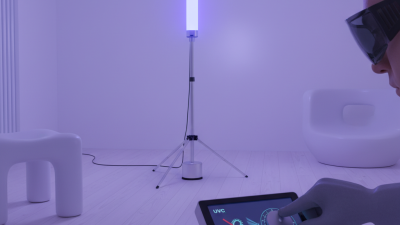
2026 Best UV Light Sanitizer for Hospital Rooms

Hospitals need cleaner rooms without disrupting urgent care. In 2026, a uv light sanitizer for hospital rooms may support that goal when teams use it carefully. UV-C devices can reach exposed surfaces after a patient leaves. They may help reduce microorganisms on bed rails, tray tables, door handles, and nearby equipment.

But light has limits. Shadows, dust, fabric, and incorrect positioning can block its effect. The room must remain unoccupied during operation. Staff also need clear warning signs, reliable cycle records, and regular device maintenance. A glowing chamber is not proof of complete disinfection.

William A. Rutala, a leading healthcare epidemiologist and expert in environmental infection control, has stated: “No-touch disinfection technologies are a supplement to, not a replacement for, traditional cleaning and disinfection.” That principle should guide every buying decision. Manual cleaning removes soil that UV-C cannot penetrate. UV-C then offers an additional layer for selected room surfaces.

This guide examines the 2026 best uv light sanitizer for hospital rooms through practical and clinical criteria. It considers irradiance, coverage, cycle time, sensor safety, documentation, service support, and staff training. Product claims deserve careful checking. Marketing numbers can look impressive.

Real rooms are messy. A device that performs well in a test chamber may struggle beside a crowded bedside table. The strongest choice is not always the fastest one. It is the system that staff can position correctly, operate consistently, and verify after every cycle. Some uncertainty remains, especially across different room layouts. That is worth acknowledging.

2026 Best UV Light Sanitizer for Hospital Rooms

UV-C Fundamentals: 254 nm, Germicidal Dose, and Log-Reduction Data

UV-C sanitizers for hospital rooms should be judged by delivered dose, not lamp power alone. At 254 nm, ultraviolet energy damages microbial DNA and prevents replication. The wavelength is useful, but distance, exposure time, and surface angle control the result. Think dose, not glow. UV-C dose equals irradiance multiplied by time, usually reported in millijoules per square centimeter. There is no universal hospital-room dose. An exposed surface receiving 40 mJ/cm² may achieve a different reduction from a shaded surface. That difference matters. Microbes vary, and published values are often laboratory estimates rather than room guarantees. Log-reduction data expresses performance clearly. One log means 90 percent reduction. Two means 99 percent. Three means 99.9 percent.

For 2026 evaluations, room validation should use calibrated radiometers, documented cycle times, and test points behind beds, rails, and equipment. Those locations commonly receive less UV-C because shadows interrupt exposure. Cleaning remains essential. UV-C does not remove dust or replace manual disinfection. Independent test reports should identify the organism, starting load, dose, distance, and measurement method. Without these details, a dramatic log-reduction claim is difficult to interpret. Safety also requires controlled access, warning systems, and confirmation that people and animals are absent during operation. Reflective walls can improve coverage, yet they do not eliminate blind spots. A useful specification should state measured dose at the target surface, not only nominal output. Even then, room geometry can defeat a perfect-looking number. That is the uncomfortable part.

UV-C Fundamentals at 254 nm

The chart shows representative 254 nm UV-C dose bands commonly associated with a 1-log10 reduction, equivalent to a 90% reduction in viable microorganisms. Dose is expressed in mJ/cm² and is calculated as irradiance multiplied by exposure time.

Actual hospital-room performance depends on distance, shadowing, surface type, lamp output, air movement, humidity, and validated measurement of delivered dose. These values are literature-based reference ranges rather than guaranteed treatment specifications.

Hospital Benchmarks: 3-Log (99.9%) Reduction and Room-Cycle Time

2026 Best UV Light Sanitizer for Hospital Rooms

A hospital-grade UV sanitizer should be judged by evidence, not lamp brightness. The practical benchmark is a 3-log reduction, meaning 99.9% fewer viable microorganisms under tested conditions. This result depends on distance, exposure time, surface type, and organism. Bed rails, overbed tables, call buttons, and bathroom fixtures need direct light. Shadows can protect contamination. A room-cycle time of 15 to 30 minutes may sound efficient, but preparation and verification also matter. Staff must remove people, cover sensitive materials, close the room, and confirm completion through the operating record.

Tips: Measure real room-cycle time from clearance to re-entry, not from switch-on to switch-off. Use routine audits, surface cultures, or validated indicators where appropriate. Keep a written checklist. Never treat one successful cycle as permanent proof. Cleaning remains necessary because dirt and organic material can reduce UV performance. A trained operator should check positioning before every cycle.

In practice, the best system fits the ward’s workflow without encouraging shortcuts. A device that meets laboratory testing but delays bed turnover may create pressure for unsafe decisions. Conversely, a fast cycle may deliver weaker coverage in crowded rooms. Review independent test data, maintenance records, sensor accuracy, and staff training requirements. Results should be interpreted carefully. A 99.9% reduction is powerful, but it is not sterilization, and room geometry can make performance uneven. Sampling after installation may reveal gaps that specifications miss.

Safety Compliance: IEC 62471, FDA Guidance, Shields, and Interlocks

2026 Best UV Light Sanitizer for Hospital Rooms

Choosing a UV light sanitizer for a hospital room requires more than checking irradiance or treatment time. IEC 62471 helps evaluate photobiological risks from optical radiation, including ultraviolet exposure to skin and eyes. A credible device should provide test evidence, risk classifications, and clear operating limits. Ask for laboratory documentation. Marketing language is not enough.

FDA guidance may affect device claims, labeling, and evidence for disinfection performance in the intended environment. It does not automatically mean every product is FDA-approved. Hospital purchasing teams should review the intended use, validated organisms, dose data, and room conditions. Dust, shadows, bed rails, and equipment can reduce UV exposure. Real rooms are rarely perfect.

Physical shields can limit stray radiation near doorways, observation windows, and reflective surfaces. Door interlocks should stop emission when a door opens. Motion sensors, warning lights, audible alerts, and keyed controls add useful layers, but they can fail or be bypassed. Staff training remains essential. I have seen safety procedures weakened by rushed turnover cleaning.

Look for service records, sensor checks, calibration intervals, and written emergency procedures. Verify that maintenance staff can identify damaged shields or failed interlocks. A short cycle is attractive, yet insufficient dose may create false confidence. Select equipment through infection-control, occupational-safety, and facilities review. The strongest choice is not always the brightest lamp. Safety evidence should be specific, current, and easy to verify.

2026 Best UV Light Sanitizer for Hospital Rooms - Safety Compliance: IEC 62471, FDA Guidance, Shields, and Interlocks
Evaluation Dimension Recommended Technical or Safety Requirement What Hospital Buyers Should Verify Compliance Significance
UV-C source band Use a documented germicidal UV-C output, commonly within approximately 200–280 nm. The exact wavelength, optical output, and operating distance must be stated by the manufacturer. Request an independent or calibrated spectral measurement, lamp or LED specifications, and the effective treatment distance. Performance-critical
Wavelength alone does not establish room-level microbial reduction.
Photobiological safety Evaluate ultraviolet, actinic-ultraviolet, and ocular exposure hazards using the risk-group methodology of IEC 62471. Obtain an IEC 62471 test report identifying the applicable risk group, measurement conditions, accessible emission, and exposure limits. Required safety evidence
IEC 62471 is a photobiological safety assessment standard, not a claim of disinfection effectiveness.
Human exposure control Direct UV-C exposure to occupied-room personnel and patients should be prevented unless the specific application has been evaluated for safe exposure. Confirm that the operating procedure requires room vacancy, controlled access, warning signs, and a documented re-entry process. Patient and worker protection
UV-C can injure skin and eyes, including through reflected radiation.
Physical shielding Use enclosed chambers, baffled designs, fixed shields, or other engineering controls that prevent line-of-sight access to active UV-C sources. Inspect the device for gaps, removable panels, exposed lamps, reflective surfaces, and leakage under normal and foreseeable misuse conditions. Engineering control
Administrative warnings should not be the only protection where exposure is reasonably foreseeable.
Door and panel interlocks Access doors, covers, and service panels should interrupt UV-C emission when opened or removed. Test every interlock during commissioning and after maintenance. Verify that the system cannot automatically restart while an access point is open. Required for enclosed equipment
Interlocks should be fail-safe and resistant to easy bypass.
Room-entry interlock For whole-room UV-C systems, use a controlled start sequence that confirms the room is vacant and prevents unauthorized entry during treatment. Verify door sensors, motion or occupancy detection where provided, emergency stop controls, audible or visual warnings, and access-control integration. Strongly recommended
A room-entry control should complement, not replace, staff procedures.
Emergency stop Provide a clearly marked, readily accessible emergency stop that immediately terminates UV-C emission. Check the stop location, reset method, visibility, response time, and whether the device requires a deliberate restart after an emergency stop. Operational safeguard
Emergency controls should be included in staff training and functional checks.
FDA-related review Review applicable U.S. Food and Drug Administration guidance and labeling related to UV-C radiation, exposure hazards, intended use, and medical-device status. Confirm the intended-use statement, U.S. regulatory pathway or listing information when applicable, warnings, contraindications, and supporting test documentation. Regulatory due diligence
FDA information does not remove the need for facility risk assessment or safe operating procedures.
Disinfection claim evidence Claims should identify the test organism, surface type, UV-C dose or irradiance, distance, exposure time, environmental conditions, and reduction method. Request complete laboratory protocols and results rather than relying only on a stated percentage reduction. Evidence-based purchasing
Results for exposed, clean laboratory surfaces may not predict performance on shadowed or soiled room surfaces.
Dose monitoring Prefer systems that measure or estimate delivered UV-C dose using calibrated sensors, validated positioning, or a documented exposure model. Verify sensor calibration intervals, dose calculation assumptions, error handling, and whether the system records completed cycles. Recommended
Cycle time alone is not a reliable substitute for delivered dose.
Shadowing and room geometry Evaluate line-of-sight limitations caused by beds, equipment, furniture, curtains, corners, and other obstructions. Review room maps, lamp placement, required repositioning steps, and any validated coverage zones. Clinical-use consideration
UV-C is primarily an exposed-surface treatment and may not reach shaded areas.
Surface compatibility Assess repeated UV-C exposure for plastics, elastomers, fabrics, coatings, labels, and medical equipment located in the treatment area. Request material-compatibility data and inspect high-use surfaces for discoloration, cracking, embrittlement, or loss of markings. Lifecycle risk
Material damage can create replacement costs and additional infection-control risks.
Ozone and secondary emissions Where applicable, evaluate ozone generation and other emissions associated with the UV source or device design. Check the source spectrum, ozone test results, ventilation requirements, and re-entry controls. Do not assume that every UV-C device is ozone-free. Environmental safety
Re-entry criteria should account for any emitted ozone or other hazardous by-products.
Lamp or LED aging Account for output reduction over service life, including lamp aging, LED degradation, contamination, and optical fouling. Verify rated service life, output-maintenance data, replacement instructions, cleaning requirements, and end-of-life alarms. Performance assurance
A device may complete a timed cycle while delivering less UV-C than expected.
Maintenance and calibration Establish documented inspection, cleaning, lamp replacement, sensor calibration, and electrical-safety checks. Confirm availability of service procedures, maintenance records, calibration certificates, and authorized repair instructions. Quality-system control
Maintenance status should be traceable for each device and treatment cycle.
Electrical and mechanical safety Assess electrical protection, grounding, cord management, stability, mobility, thermal management, and resistance to tipping or impact. Review applicable electrical safety certifications and perform a site-specific inspection before clinical deployment. General equipment safety
UV-C performance does not substitute for electrical, fire, and mechanical safety review.
Hospital workflow integration Use UV-C only after routine cleaning and according to the facility infection-prevention protocol. Define responsibility for room release, device placement, cycle selection, failed-cycle response, and final room sign-off. Process control
UV-C should be treated as a supplementary environmental-control measure, not a replacement for manual cleaning.
Training and records Provide role-based training covering hazards, room clearance, controls, emergency stop use, maintenance, and incident reporting. Maintain operator competency records, treatment logs, failed-cycle reports, maintenance history, and exposure-incident procedures. Recommended governance
Documented use supports auditability and continuous improvement.

Important: IEC 62471 addresses photobiological safety, while FDA guidance addresses applicable regulatory and safety considerations. Neither standard by itself proves that a UV-C device will disinfect every hospital-room surface. Final selection should be based on documented testing, facility risk assessment, infection-prevention requirements, and local regulations.

2026 Product Testing: Irradiance, Coverage, Runtime, and Validation

Selecting a UV light sanitizer for hospital rooms should begin with measured performance. A bright lamp or impressive brochure proves little. During product testing, I record irradiance at the floor, bed rail, mattress edge, and high-touch surfaces. A calibrated radiometer matters because quoted output may describe the lamp, not the delivered dose. Distance changes results quickly. Dust, aging bulbs, and reflective angles can also reduce exposure.

Coverage testing uses a room map with marked points, including corners and shadowed areas behind equipment. I compare readings at several distances and calculate whether each location receives the intended dose. One reading is not enough. Shadows remain a stubborn weakness. A unit may perform well in an empty test bay yet miss the call button behind a monitor. That finding is useful, even if disappointing.

Runtime testing measures dose stability from startup through the complete cycle. I check warm-up time, automatic shutoff, sensor response, and output after repeated cycles. Validation should combine instrument records with surface sampling or appropriate biological indicators, handled by qualified infection-control staff. Results need room size, setup, distance, and environmental conditions. Human error is still possible. A rushed setup can make a capable device look unreliable, so staff training and repeat testing deserve equal attention.

Selection and Use: CDC/WHO Controls for Occupied and Vacant Rooms

2026 Best UV Light Sanitizer for Hospital Rooms

Selection and Use: CDC/WHO Controls for Occupied and Vacant Rooms

Choosing a UV sanitizer starts with room status, not lamp power. CDC guidance treats ultraviolet germicidal irradiation as supplemental, never a replacement for cleaning, ventilation, or hand hygiene. In vacant rooms, staff should remove people, animals, and sensitive materials before exposure. Use door interlocks, warning signs, timed cycles, and documented dose verification. Direct UV-C exposure can injure eyes and skin.

Occupied rooms require stricter controls. Only properly shielded upper-room systems should operate around patients and staff. Their installation needs measured irradiance, adequate ceiling height, airflow assessment, and routine maintenance. CDC tuberculosis guidance identifies upper-room UVGI as a possible airborne-control measure, but performance depends heavily on design and maintenance. A portable direct-exposure lamp should not run in an occupied room.

WHO’s 2022 Global Report on Infection Prevention and Control notes that effective infection-prevention programs may reduce healthcare-associated infections by up to 70%. UV devices support that program; they do not replace it. ASHRAE’s 2023 HVAC Applications guidance also positions UVGI as a supplementary engineering control. One practical limitation is often ignored: bed rails, mattress seams, and equipment shadows may receive little dose. Surface cleaning must come first. Operators should record cycle time, room dimensions, lamp output, sensor checks, and failed cycles. The difficult question is not whether the lamp works in a test chamber. It is whether the real room receives a verified, safe dose every time.